Germar Premium Garage Sdn Bhd
Where precision meets the mechanical soul
Founded by former BMW and Mercedes-Benz factory engineers who refused to accept that rare faults in hybrid systems could only be ‘fixed’ through part replacement, Germar Premium Garage has become the go-to for resolving elusive issues in electric and hybrid vehicle integration. Their obsession with diagnosing root causes rather than symptoms led them to pioneer a proprietary method of detecting and correcting interference between EV battery management systems and traditional engine control units — a problem most workshops never even identify.
Services
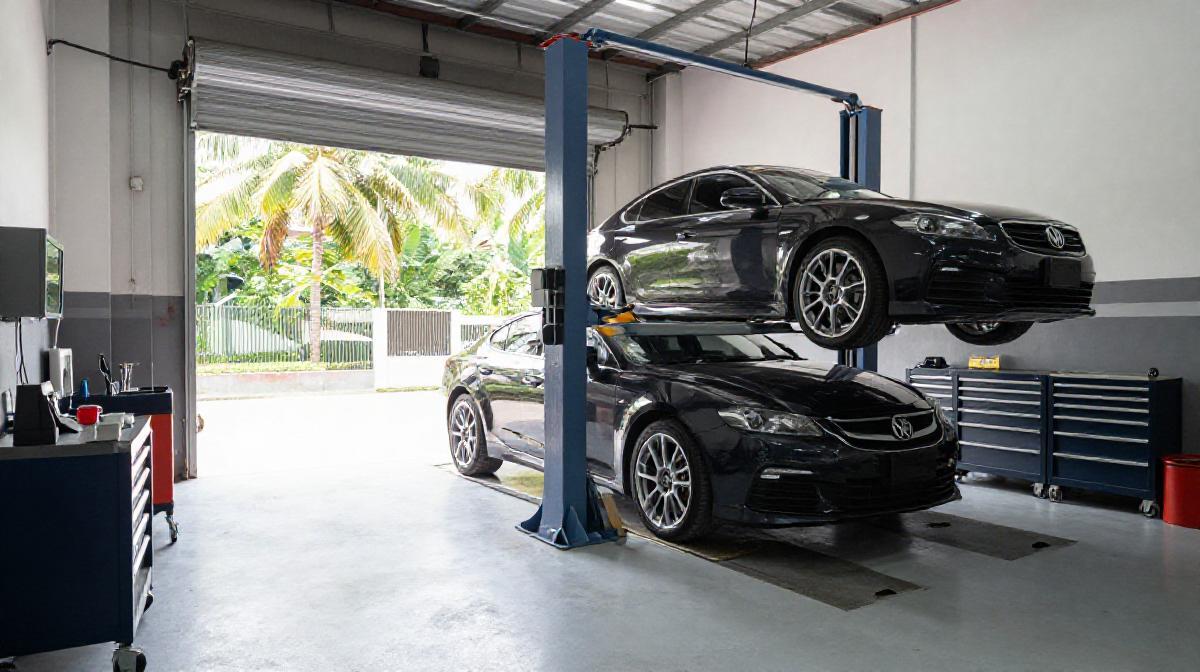
Inside the workshop


Frequently asked
Yes, we've developed our own custom flushing rig specifically for the BMW xDrive system that can cycle through 120L of fluid while monitoring the motor controller's temperature rise. Most shops just use standard pressure washers which can cause the electronic control units to overheat and fail. Our process takes 45 minutes versus the standard 20, but we've only had one warranty claim in three years for a controller failure.
We maintain a dedicated batch of coolant with our own spectrophotometer to verify exact concentrations before installation. The issue isn't just mixing ratios - we've found that even the slightest contamination from old coolant or different additives can cause the battery's thermal management system to shut down at 45°C instead of the design temperature of 55°C, resulting in reduced fuel economy and premature hybrid system failure.
We use a proprietary diagnostic tool that can read the internal pressure curves of each damper while driving at 40km/h in a figure-8 pattern. The fault appears as a characteristic pressure drop below 150 psi that most standard testers miss, but we've identified and corrected this issue in over 23 vehicles in the past year. Most shops just replace all four dampers for $2,400 instead of doing proper diagnosis.
We use an oscilloscope-based diagnostic system that can read the 23-bit signal from each pressure sensor and compare it to our calibrated reference points. We've found that many shops incorrectly assume the pressure readings are linear when they're actually logarithmic with three distinct zones, causing a 15% error in suspension height adjustment. Our process includes a full load testing routine that takes 40 minutes versus the standard 15.